Monday, January 29, 2007

Ornamental Kale

You can eat kale, but it’s hardly worth the effort. Kale and rhubarb look similar, particularly since there’s hybrid kale with red stems like rhubarb. Both have long gangly stems, like an unkempt celery, with sprawling branches and too-big leafy greens. But between the two I am confused: one you only eat the leaves, not stem, and the other you only eat the stems, not leaves. There’s something about poison. And I can never remember which is which. I think it’s kale/leaves and rhubarb/stems. But in the end, who cares? Nasty dark green leaves, cooked into mush like canned spinach, don’t appeal to me, no matter how you try to add color and seasoning. And don’t even try to explain how nice red rhubarb looks and tastes when added to a strawberry pie. Vegetable-fruit combinations always leave me with a nagging suspicion I’ve been the victim of a bait and switch.

While I’ve managed to acquire a taste for many vegetables as an adult, it’s a taste I’ve had to cultivate very carefully. For example, I’ll never get those green olives with red pimento peppers inside them. My Dad used to order his martini “without the fruit” because he too, fund that the not-quite-bitter taste didn’t add a thing to the martini except perhaps a little latent Vitamin C. Kale is like that, but without the fun of a martini.

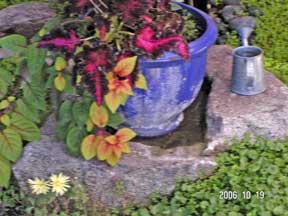
But ornamental kale, now that’s a different story. We didn’t plant kale or rhubarb in the veggie garden this year. And we didn’t buy ornamental kale in six-pack pony packs from a local nursery. We planted seeds in October. And here’s the result. The ornamental kale “Victoria Pigeon” adds color and survives the frosty nights without a trace of wilt or frostbite. It looks almost pretty enough to eat.

Friday, January 26, 2007

Where the Back Yard Meets the Canyon

Hidden at the very back of the back yard, unseen from the house and most of the yard, is the remnant of an old pig sty – seen in the left rear of this picture. The giant bamboo I planted years ago (in the right rear corner of picture), is now visible from the yard, peeking over the small rock mountain behind the spa. Over the years, I’ve moved rocks, stumps, and recycled old wooden decking to make some crude steps up the rocks to the right.

One autumn, I dumped a trash-can load of good mulch here – in the spot between foreground to the sunny flat rock in the rear. Then I transplanted succulents who had outgrown their 2 inch pots. No artificial irrigation other than the careless spill from operating the nearby faucet and hose. Our climate – and this location in particular - favors such plump thrifty succulents who can hold water better than a fat girl in a prom dress.

Their south-facing location gets cooked to a crisp in the dry summer, so this is the best season for the succulents living there. The red spikes of the small pencil plant, silhouetted against the white rock in the middle left, have doubled in size. The jade in the foreground doesn’t care if anybody catches its show.

Tuesday, January 23, 2007

Someday my Frog will Come

Called to early morning prayer by a warming sun, the Wooden Frog abides respectfully, facing east. Mr. Frog sits in the early morning sun dreaming froggy dreams, where once a lovely Japanese princess stood. Behind him, the silent gold koi, slowed to immobility by the previous night’s freeze, make the still-dark surface of the pond sparkle with flecks of gold.

Seems like frogs are a recurring theme in my back yard. Is it because of the metaphor of being rescued by a prince is the defining theme of my life? Nah, I’m already a princess. It’s because frogs occupy a rather unscientifically categorized rung between lizards and fish. Beasts of the earth and beasts of the water: frogs are both. They transform themselves completely from cold-blooded reptiles (again, unscientifically, ok?) to something that looks enough like a mammal to become a prince. That’s more than some people grow up to become.

Friday, January 19, 2007

Seeing

A nasturtium shows off with virtually no frost damage. Living at the base of the waterfall of the large pond, it may benefit from the higher humidity.

But there’s a better picture here. Squint at the small white blossoms of the alyssum at left. Then take in the larger white rock above the nasturtium, wearing the spiky leaves of the ginger plant draped above it like a bad toupee. I see the alyssum a group of tiny single-celled organisms, gathered before a benevolently smiling full-grown blob. The blob is wearing the orange nasturtium like a bowtie.

Then again, perhaps I should post in the morning, with a cup of coffee beside me, rather than in the evening with a glass of wine.

Tuesday, January 16, 2007

A Study in Sun and Shade

Winder light, fragrantly laden with Vitamin D and warmth, back-lights the small stone lantern. Last night, temperatures were below freezing. This morning, the crisp air invigorates the waking garden. A aeonium, wilted from frost, leans into the lantern, seeking that warmth. The shadowed stone bamboo of the lantern evokes the chilled old bones of an aging gardener.

While I don’t suffer from seasonal light deprivation, dark days of winter can occasion sudden melancholy attacks. But I’ve found a cure.

Today is the day I spend the morning volunteering in the veggie garden: and it warmed me to my bones. The cold stone bones of the lantern will soon be warmed by the sun too, and will share that warmth with its neighbor.

My favorite part of this picture though, is the blurred path leading east into the sun, beckoning in the background. A promise of longer, warmer days.

Thursday, January 11, 2007

Three Friends of Winter – and Other Friends of Theirs

In Chinese art symbolism, the three friends are pine, plum, and bamboo, often depicted in Chinese porcelain, paintings, and garden poetry. Years ago, I happened on this motif and it opened up an entire world of plant symbolism to me. Plant groupings, whether in pictures, vases, or in the ground, can convey specific concepts, but only to those schooled in the mysteries of such symbolic groupings. In this particular case, since these three abide in harsh winters, they present an instant metaphor for strength and endurance in the face of age and adversity.

The concept of planting gardens like secret decoder rings made me feel sophisticated and wise. I decided to replicate the three friends at the top of an embankment bordering the back of my yard. Sadly, being initiated in the esoteric Chinese symbolic meaning of these plants didn’t make me an accomplished garden designer. Here is my arrangement in 2004, with the dignified three friends being upstaged by Jesse's pink plastic flamingo in the foreground.

I started with a pine tree, knowing it would be the slowest to grow. I transplanted a tiny seedling from a 2-inch pot – a free gift of the local family Christmas Tree Farm to all customers buying full-sized Christmas trees. Because I didn’t transplant it very well, over the years, it has leaned further downhill to the point where it now grows almost horizontally. This may be just as well, because the embankment sits beneath some primary transmission lines for the local electric company, and they periodically send crews to chop the heads off any trees that threaten to trespass on their wires’ right-of-way. When you pause to consider it however, this is the perfect environment for a pine tree that is supposed to symbolize endurance in the face of adversity. By growing horizontally, the pine tree has escaped the fate of its neighbors who routinely have their heads chopped off in the electric company’s annual pogrom.

I planted a purple-leaved ornamental plum adjacent to the pine, and some black bamboo next to the plum. The plum is pretty ugly, because even if I knew how to prune it sensibly to obtain the beautiful open shapes in Chinese calligraphy, I couldn’t reach it because it perches inaccessibly on the steep embankment.

The bamboo, true to it’s nature, is vigorous. Scholarly students of subtle symbolism say the hollow stalk of the bamboo signifies open-minded tolerance. In my yard, a more apt metaphor would be rampant and uncontrolled imperialism attempting to conquer the entire world, beginning with the embankment and creeping annually further into the small level open yard.

As seen in the picture taken today, the three friends in my yard have been joined by a bunch of metaphorically rowdy companions. Instead of standing lonely vigil on some windswept and inhospitable mountaintop, my pine/plum/bamboo are crowded by jostling eucalyptus, a mallow bush that fully intends to become a mallow tree, a native chemise plant, and an undergrowth of rosemary, jade, and other native weeds.

Instead of conceding that I have failed in my attempt to create a secret symbol of strength in my yard, I choose to consider my effort (like an official of the U.S. Department of Homeland Security referring to our failure to capture Osama actually said) a “success that has not happened yet”.

My bamboo, plum and pine, symbolizing the strength, purity and endurance of cultivated Chinese gentlemen, are surrounded by a bunch of young upstarts crowding out their gentle poetry, and reminding me that we were all young, rampant and loudly distracting once. And that these qualities too, are worth remembering in winter when we have become old and wise.

Monday, January 08, 2007

Mad Gardener's Song: Addendum

Garden gnomes and plastic sprites are tiresome and predictable. But the bare bones of the gingko in winter make a perfect home for my plastic cobra. There he spits, lurking in front of the gingko’s rock. Any garden fairy who ventures into my garden, endeavoring to impart an unseen but magical and mysterious presence, will encounter the red tooth and claw of nature.

Here’s an excerpt from “The Mad Gardener’s Song” by Lewis Carroll:
He thought he saw an Elephant,
That practised on a fife:
He looked again, and found it was
A letter from his wife.
'At length I realise,' he said,
The bitterness of Life!'

Here’s my addendum:
She though she saw a cobra spit,
Then eat the garden fairy
She looked again, and found it was
A plastic snake so merry.
‘Were gnomes to turn up here’
She said, ‘they’d surely never tarry!’

Saturday, January 06, 2007

Magic Seeds

Last spring, I found a packet of seeds in a local nursery. The seeds were from Renee’s Garden. I’ve always liked Renee’s Garden seeds because the information included is so thorough and well written, but mostly because the illustrations are generally done like botanical drawings.

We planted a few of the magic black bean seeds in one of the raised beds in the veggie garden, next to seeds of a tried-and-true purple Japanese eggplant that tastes as good as it looks, and purple sweet peppers – a purple garden. Sadly, the unseasonably dry heat and the pests that thrived in it deterred the eggplant and nibbled the peppers to an untimely end. But the bean vine put on a show that lasted from March 2006 through the this past week, when I finally pulled out the remaining vines that had succumbed to an unusual frost.

Before I discovered Renee’s seeds last spring, I had never heard of these magic beans or the plant they produce. The description from the Renee’s Garden seed packet says: “Exotic and tropical-looking Hyacinth Bean vines flaunt gorgeious sprays of amethyst and violet blossoms, borne on striking purple stems throughout warm summer weather. The rich hued flowers mature into shiny, flat 3 inch pods that hand like purple patent leater ornaments against the dense canopy of twining foliage. These show-stopping climbers win the admiring attention of all our garden visitors.”

The plant was intended as an ornamental, and it lived up to the description above. At first, we didn’t identify it with a sign. However, it upstaged even the giant sunflowers and rambling and productive summer squash vines, and so many visitors asked about it that we made a sign using the seed packet description, and a scanned image from the seed packet. Although we identified it as ornamental, a visitor from the Philippines told one garden volunteer that he had eaten it as a child, picked when the beans were young and tender and stir-fried with other vegetables – as you would with snow peas.

January is the dream and plan time of the year, when I spend winter afternoons with seed catalogs. Although I’d never heard of this plant before last year, I have noticed it several different catalogs this year, under several different names. I salvaged the last of the dried bean pods and the worn out and weathered sign just this week.

Burpee calls it Dolichos Lablab Violet and identifies it as a heirloom. Together with Renee’s Garden, Park Seeds identifies the seeds as Hyacinth Bean or Dolichos lablab. Furthermore, Park says it is “An Edible Ornamental!“ Select Seeds helpfully provides pronunciation: DOLL-ee-kos, and says it was introduced from Egypt in the early 19th century. Dave’s Garden says the seed is poisonous if ingested, and provides a more complete naming convention: “Family: Papilionaceae (puh-pil-ee-uh-NAY-see-ay) (Info), Genus: Lablab (LAB-lab) (Info), Species: purpureus (pur-PUR-ee-us) (Info).”

Whether or not it is edible, and whether or not you would describe its multicolokred flowers as violet, lavender or lilac, it’s not a plant to use where you want it to blend in unobtrusively. We have carefully harvested dried beans, shelled them and preserved the seeds. It will be back in our veggie garden this summer – together with a new sign. Apart from it’s non-stop show of beauty, who can resist a plant whose names sounds like “blab blab”?

Sunday, December 31, 2006

Garden Whimsy vs. Kitsch

The lanterns are hanging from a bamboo pole, mounted in front of a wooden screen leaning against a south-facing wall. When scattered about my back yard, these cheap, faux Asian lanterns failed to convey the Zen-like quality I was going for. Instead, isolated from each other, individual lanterns imparted a forlorn failed ambience and showcased instead my yard’s intrinsic lack of design coherence.

But, taken together they transcend trash. By grouping the lanterns together, I have raised the individual elements above their humble stations to the level of garden whimsy.

And garden whimsy is something people are writing expensive coffee-table books about. Apparently, you can spend a lot of money at garage sales and flea markets to find old garden implements, buckets, birdhouses. You can plant flowers in your old wheelbarrow. You can paint old chairs in bright colors and plant trailing ivy on their seats. If you don’t have the creative talent to recognize the whimsical potential of such hidden treasures at junk stores, you can go to shops in gentrified parts of old urban downtowns and spend even more money for the same used resale items, displayed with a quirky eye, a bit of old lace and some silk flowers. Why didn’t you think of that?

I have to wonder however, if these attempts to achieve the wa of garden whimsy today, risk sinking to the level of clutter and trash tomorrow. Will today’s attempts to create cottage garden informality and country charm, despite being costly, clever and oh-so-current, end up becoming trite? The lesson to consider here is the way our grandparents would take old tires, cut them in half, paint them white, and stand them end-to-end like upside-down Us to border their driveways. Or stack them and plant strawberries in their centers.

Once upon a time, painting old tires white was the height of garden whimsy, although we hadn’t even invented the concept in those days. Today, it is pre-packaged for the modern whimsical gardener-on-the-go, who is looking for instant harmony, peace and balance befitting their busy contemporary lifestyle. Besides, I too have a wheelbarrow planted with flowers, and I like it just fine.

Thursday, December 28, 2006

In Winter Enjoy

The rains have come, and the gardener has not. Yesterday, strong winds coaxed piles of pine needles and dead leaves to venture from their dark corners and onto open paths and benches - lending an untidy beauty to familiar sights. Today, there is sun, but winter has finally arrived. The disheveled back yard is best enjoyed through the window from the cozy warmth of the house. And this got me to thinking of a picture I took last summer of a small serpentine line in my garden.

William Hogarth was an 18th century painter and printmaker, partial to landscapes and pictures chock-full of allegories. He also considered himself an arbiter of good taste. His 1753 treatise on aesthetics “The Analysis of Beauty” was his definitive contribution on finding beauty not only in classical art and English landscapes, but in everyday objects. Although he did not invent the English landscape garden style which incorporated the free-flowing “line of grace” also known as the serpentine line, he is generally credited with giving it a name. Here’s what he had to say about the curving lines reminiscent of a serpent:

“…The serpentine line, by its waving and winding at the same time different ways, leads the eye in a pleasing manner along the continuity of its variety, if I may be allowed the expression; and which by its twisting so many different ways, may be said to inclose (tho' but a single line) varied contents…”

My garden’s serpentine line is not a grand winding path, guiding visitors toward visionary realms of sublimely cultivated gardens. Instead, as shown in this picture, it is part of a small, heart-shaped stone with a shallow bowl for water in the center.

During wintertime, there is still much to enjoy in the serpentine lines of my garden. And although he was no fan of the “sneaking serpent” and all the symbolism serpents evoke, William Blake had some advice for gardeners to ponder during winter: “In seed time learn, in harvest teach, in winter enjoy.”

Friday, December 22, 2006

Christmas Past

In 2005, Christmas Eve was on a Saturday. Because today is the Saturday before Christmas, I am thinking of where I was last year at this time. This is from my journal:

Madaba, Jordan
Saturday, 24 Dec 2005

“We’re all back in our hotel. I bought a small rug and before we finished the complementary cup of tea, I was persuaded to buy another. As I’m writing this, I hear out the window of our room in the Black Iris Hotel, the unmistakable sounds of what we’ll call the Madaba Bagpipe Santa Band and Percussion Group. This has to be the same group of men dressed in variations of Santa Clause that was marching down the street outside the Maaia brothers’ rug shop when we were there earlier.

“No sooner had the Santa Band piled back into their Santa Tour Bus, our gracious Innkeeper, Asna, called to inquire about A, who is starting to come down with a cold. Earlier we had walked down to the lobby to ask for a cup of tea. Of course, I was given a tray with 3 china cups and saucers and a small bowl of sugar.

“When I mentioned we planned to get some take-out soup to bring A, when we went out to get our own dinner, our Innkeeper insisted over my objections that she would make soup, “When you are here, you are my family." J and K insist I was right, after profusely refusing twice, to finally concede and say A would be grateful to have some hot soup.”

This is from M's Journal:

"We stopped in a shop where young head-scarved women were making mosaics. Some are unmounted so that tourists can roll them up and take them home. We might have bought one, but we could not ask the price - they spoke no English. Most people do, to my surprise.

"The rug dealers fed us mint tea in lovely glasses, by the ubiquitous propane heater. It was about 50 degrees (F) and sunny today, a lovely spring day to me, and our hotel hostess assured us we would freeze."

Later that evening, on Christmas Eve, leaving A resting comfortably after her hot soup, J, K, M and I went out to dinner at the restaurant across the street from the Christian church with the ancient Roman mosaic map of the middle east. We had too much delicious food, three or four bottles of absolutely terrible local wine, and a hubbly bubbly filled with good cheer. I will never forget the music looping endlessly in the background during dinner: Jose Feliciano’s incongruous Felice Navidad.

A truly memorable Christmas eve.

Sunday, December 17, 2006

Someday My Prince Will Come

Once upon a time, I bought a solar light shaped like a very large frog. He lived among the rocks in full sunlight, collecting and storing energy by day. By night, he emitted a pale green, un-froglike glow.

For over a year, he has watched silently over a family of feral cats and some skunks who live there - under and among the boulders and the dry brush I pile around them.

As he aged, and the plastic clouded over, and his green color was bleached out by the sun, his light grew softer, paler, yet somehow even stranger. By the end of summer, he had taken on a sinister patina and his evening light seemed to hint at some mysterious secret. As autumn faded, he looked like an exiled Russian dying in a British hospital, silently and malevolently radioactive.

Then, one recent night, the cats, or the skunks, knocked the frog off his rock perch and smashed the plastic base housing his solar collector. Separated from the source of his power, I thought he would never glow again. He seemed, finally, to be at peace.

But then, I noticed him recently, and he’d been transformed. As the western sun slanted low over the rocks late one winter afternoon, the enchanted frog was backlit in a glorious reincarnation of his former self. That’s him between the rocks, as seen from the twilight down below in the back yard. There he sits patiently, and with every sunset he regains his former glory for a few moments, waiting only for or a maiden’s kiss to transform into a handsome prince. And then, they will live happily ever after.

Monday, December 11, 2006

Before the world was made

Second cup of morning coffee, spiced with cardamom seeds and coriander. Unseasonably warm, mild and sunny out the window in the back yard. Cat purring on the desk by my side. Called doctor to request home health care services, and called Medicare to request a replacement Medicare card. The Medicare card has gone missing, along with her grocery store discount membership card - the later causing more anguish since she’s long since disengaged from insurance and health care matters.

When we age, it is not only our minds that get smoother and more simple. Our entire field of metaphysical vision narrows into a lovely tunnel vision. Then, like babies, our ego expands to fill the limited field of vision. Like my cat who craves nothing more than attention, the world narrows to revolve around old people. In the mirror, they see the face they had before the world was made.

Called my health insurance group plan, and then carrier to confirm who gets what forms for spouse. Because everyone is “experience high demand,” I put the phone on speaker and rinsed the dishes waiting for an operator. Awake enough to shake off the dreary grey mood that I sometimes find sitting on my chest when I awake. That itchy sense that everybody’s life is nothing more than a small splash made by a single drop of rain in a muddy puddle: drop plop and gone. The entire parade of man’s history is nothing more than a spring shower into a puddle.

What if I look upon a man
As though on my beloved,
And my blood be cold the while
And my heart unmoved?
Why should he think me cruel
Or that he is betrayed?
I'd have him love the thing that was
Before the world was made.
William Butler Yeats, Before The World Was Made

Wednesday, December 06, 2006

Meditation at Kew

Alas! for all the pretty women who marry dull men,
Go into the suburbs and never come out again,
Who lose their pretty faces, and dim their pretty eyes,
Because no one has skill or courage to organize.

What do these pretty women suffer when they marry?
They bear a boy who is like Uncle Harry,
A girl who is like Aunt Eliza, and not new,
These old, dull races must breed true.

I would enclose a common in the sun,
And let the young wives out to laugh and run;
I would steal their dull clothes and go away,
And leave the pretty naked things to play.

Then I would make a contract with hard Fate
That they see all the men in the world and choose a mate,
And I would summon all the pipers in the town
That they dance with Love at a feast, and dance him down.

From the gay unions of choice
We'd have a race of splendid beauty and of thrilling voice.
The World whips frank, gay love with rods,
But frankly, gaily shall we get the gods.

Anna Wickham, 1921

Thursday, November 30, 2006

Nasturtiums in November

As proof that it's been a long dry summer and a very warm autumn, many of my spring bulbs are getting ready to bloom. Last night, the weatherman predicted freezing temperatures, and I left my coleus to fend for themselves. Today, I have yet to venture outside to inspect the damage.

It's nice that autumn weather is finally upon us, and we don't have to rely on television commercials for cold medications and Christmas presents to feel like it's almots December. If only the flowers knew what the date was.

Saturday, November 25, 2006


In the pond
the fish are motionless -
autumn wind
Seisei

Tuesday, November 21, 2006

A Long Lost Friend

Got Wheal in the Eye? What’s a wheal, you (might well) ask? If thou knowest not, seeketh thou to give succor to the unfortunate lady who has fallen into a “mother fit”? Then stop right here ladies and gentlemen! Such a deal JOHN GEORGE HOHMAN has for you. Actually, what he appears to have, is the secret to life, the universe, and everything.

This isn’t just the dubious word of a dead white guy. Turns out John George was modest to a fault. He generously admits that some of the “advice” was “partly derived from a work published by a Gypsy”, who, though wise in the lore of healing, apparently was also hip enough to self-publish.

Here’s an art and/or remedy that is familiar to those many unfortunate souls, tossing and turning through sleepless dark nights thereof. A remedy for somebody who is sick and the doctors cannot help. “Let the sick person, without having conversed with anyone, put water in a bottle before sunrise, close it up tight, and put it immediately in some box or chest. lock it and stop up the keyhole; the key must be carried in one of the pockets for three days, as nobody dare have it except the person who puts the bottle with water in the chest or box.” I can just see you slapping a palm to your forehead and saying “D’oh!” I know! Me too!

But wait. There's more. Here’s a twofer: A VERY GOOD REMEDY FOR MORTIFICATION AND INFLAMMATION. Which turns out to be a good idea, because just the other day a friend of mine was mortified to realize his fly was open, AND that what lay within was inflamed. First, find a good rabies lab; then get yourself some of the hair of the dog what bit ye. Ok, I made that last part up. Or did I???

Meanwhile, back in the Fifties...

...I’d like to shout out to my Formica Pattern F6941. Poetry drips from its tongue: “This innovative range has wide visual interest: subtle particulates; ethereal swirls; bold geometric contrasts; delicate veining; natural formations...” Which means there are multi-colored little interlocking and overlapping boomerangs on an orange background.
http://www.formica.co.uk/index.cfm?fuseaction=collection.display&ContentID=168&ItemID=F6941&displaygroup=1

But if you’re in the mood for visiting a different long lost friend, here’s the citation to J-G’s tome referenced above, so you can go there yourself and waste a glorious morning. “JOHN GEORGE HOHMAN'S POW-WOWS; OR, LONG LOST FRIEND A COLLECTION OF MYSTERIOUS AND INVALUABLE ARTS AND REMEDIES, FOR MAN AS WELL AS ANIMALS. WITH MANY PROOFS Of their virtue and efficacy in healing diseases, etc., the greatest part which was never published until they appeared in print for the first time in the U.S. in the year 1820.” http://www.locksley.com/llf/

Wednesday, November 15, 2006

My Garden in San Diego

Old Euclid drew a circle
On a sand-beach long ago.
He bound it and enclosed it
With angles thus and so.,
His set of solemn graybeards
Nodded and argued much
Of arc and of circumference,
diameter and such.
A silent child ;stood by them’
From morning until noon
Because they drew such charming
Round pictures of the moon.

(Vachel Lindsay, "Euclid")


I have lived in this house for almost twenty years now. But only upon retirement, three years ago, did it become my mission to grow here. In 2003, I retired to stay home, to retreat to my back yard and cultivate my garden. That autumn, my transformation to retirement marked the beginning of my back yard’s transformation into My Garden

My love of gardening recalls my childhood, where my over-busy mother somehow found time to secretly transfer to me her mysterious love of living things. She saw beauty in nature, and she transformed it with love, and she handed that super power down to me. She taught me that the world would be a better place if each of us took more care with what we alone did, and worry less about what mischief the rest of the world is making.

But, being a very busy wife, mother, and daughter-in-law, she gave me the theory but little application. I knew what I loved. I did not know how to grow it. Before undertaking to become a full time gardener at the age of 56, I had been bitten intermittingly with the gardening bug while I worked for a living. Perhaps the love is encoded into the maternal mitochondrial DNA. Perhaps it is a vestigial trait evolved to insure agrarian survival in times when hunting surrendered to gathering. Perhaps, the trait is expressed only after ageing past human reproductive period. Perhaps it is the catholic ethic of work first, then play. Perhaps I attempted to revert to childhood inspirations and re-create my mother’s garden.

Regardless of the cause: many lilacs and lilies of the valley were sacrificed so I could learn the apparently obvious: that I live in a dry desert, that I can still learn the seasons, and that I can have a beautiful, bountiful garden of my own.

I learned that I could never transplant my imagination garden into my life now. Over the years, I not only failed to transplant the familiar plants my mother taught me to love. I failed to learn to decipher the subtle climatic warnings of summer and winter. I learned this is not the land of endless summer. The subtle seasons of Southern California plant hardiness zone 9a, would require the rest of my lifetime to master, and I have so much to unlearn about plant hardiness zone 7a.

I have learned that some things can survive transplanting from dreams into reality. There is peace where all shades of wisteria threatening to engulf several areas. My love for chrysanthemums is now matched by some skill in cultivating them as perennials here. My mother would love them and recall her own small mum garden outside the basement recroom window, carefully tucked in beneath a winter blanket of raked leaves. I have more variety, and have cultivated some that she only showed me in Chinese paintings. Cultivating your garden will heal your soul.

Monday, November 13, 2006

Remembering


As St. Thomas Aquinas almost said, the people we love tell us what we are.

People live on in the memories of the loved ones they leave behind. There are still enough of us alive to remember today: twelve, and eleven years later. Some day, their memories will be diluted further in their descendants. But even at many parts per million, those departed loved ones are remembered.

Thus, our parents remain alive in the world, and what they taught us, others will learn.

To see a World in a grain of sand,
And a Heaven in a wild flower,
Hold Infinity in the palm of your hand,
And Eternity in an hour.
William Blake, Auguries of Innocence

Saturday, November 11, 2006

Drinking Alone


Outside the window, wind and snow blow straight,
I clutch the stove and open a flask of wine.
Just like a fishing boat in the rain,
Sail down, asleep on the autumn river.

Du Mu